Long hours at a desk can leave your shoulders rounded, hips tight, and back tired. Learn how Pilates builds strength, mobility, and body awareness to improve desk posture, support healthier movement, and help Miami professionals feel better throughout the workday.
Why Sitting All Day Changes Your Posture
Whether you work in a Miami office, manage a business from home, or spend your day commuting across South Florida, sitting can quietly shape the way your body feels and moves. A few hours at a computer may not seem like much. Repeated every weekday, however, it can create stiffness, muscle imbalance, and habits that follow you long after work ends.
Common desk posture patterns include a forward head, rounded shoulders, a collapsed chest, and a lower back that either rounds too much or arches too deeply. Your hip flexors can become tight while the glutes and deep abdominal muscles become less active. This does not mean sitting is automatically harmful. It means the body needs regular movement, strength, and variety.
That is where pilates posture training can make a real difference. Pilates does not ask you to hold a rigid “perfect” position all day. Instead, it teaches you how to find balanced alignment, use the right muscles, breathe with control, and move out of one position before discomfort builds.
The desk posture cycle
When your screen is low or your chair does not support you well, it is easy to lean forward. Your neck muscles work overtime to hold up your head. Your upper back may round, while the muscles between your shoulder blades become underused. Add a busy schedule, stress, and skipped movement breaks, and the cycle continues.
Many people also try to fix their sitting posture by pulling their shoulders back hard. That can create more tension. Better posture is not about forcing your body into one stiff shape. It is about having the strength and mobility to sit, stand, walk, exercise, and change positions comfortably.
How Pilates approaches alignment differently
Pilates alignment starts with awareness. In a class, you learn where your ribs, pelvis, shoulders, and head are in space. You then practice small, controlled movements that help these areas work together. This is useful for office workers because daily posture problems are often subtle before they become noticeable.
For example, a Pilates instructor may cue you to lengthen through the back of the neck, soften the ribs, stabilize the pelvis, and widen across the collarbones. These are not just exercise cues. With practice, they become useful reminders when you answer emails, drive on I-95, or sit through a long meeting.
How Pilates Improves Posture and Reduces Desk Tension
Pilates supports posture correction by strengthening the deep stabilizing muscles that help your body stay organized during everyday movement. It also improves flexibility where desk work often creates restriction. The result is not a military stance. It is a body that feels more supported, mobile, and resilient.
It strengthens the deep core
Your core is more than your abs. It includes deep abdominal muscles, the diaphragm, muscles around the spine, and the pelvic floor. These muscles help support your trunk as you reach, sit, stand, and carry things. When they are weak or poorly coordinated, other areas may compensate, especially the neck and lower back.
In posture correction Pilates, exercises such as toe taps, dead bug variations, bridges, and controlled leg work teach the core to engage without gripping. You learn to stabilize while breathing normally. That matters because holding your breath and tensing everything is not sustainable at your desk.
It opens the chest and activates the upper back
Desk work often puts the arms in front of the body for hours. Pilates balances that position with movements that strengthen the upper back, rear shoulders, and muscles around the shoulder blades. At the same time, gentle chest-opening work can reduce the feeling of tightness across the front of the shoulders.
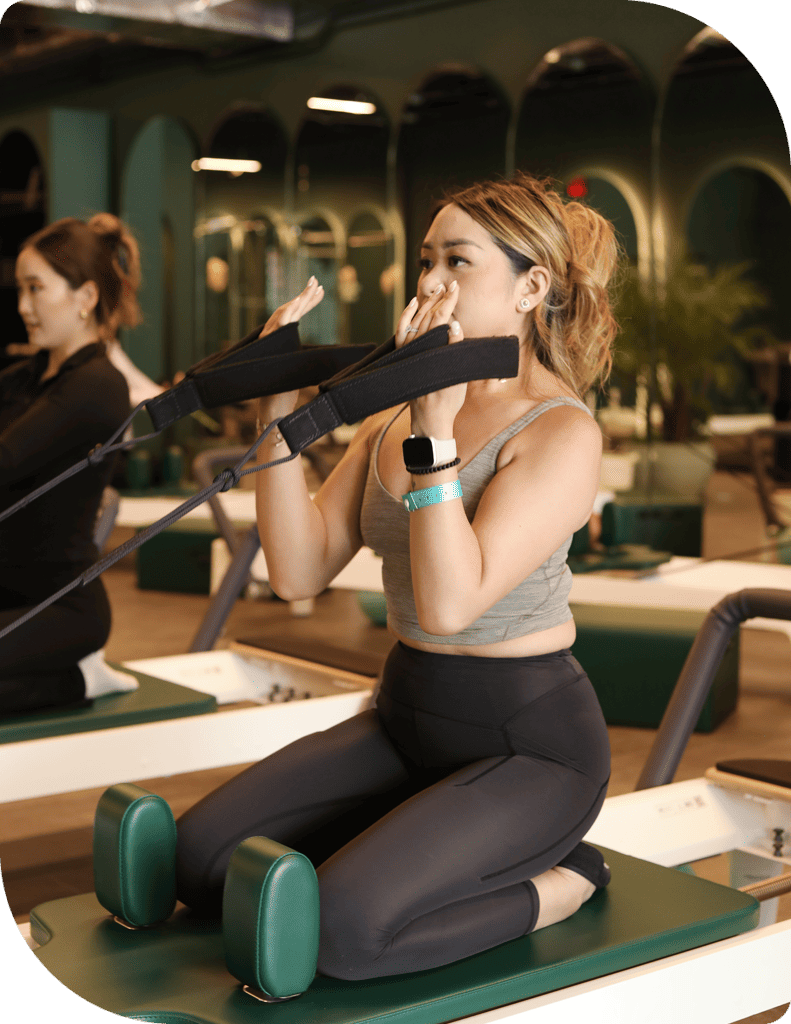
Movements like rowing, pulling straps, swan preparation, and chest expansion can help you practice a more open upper-body position. On the Reformer, spring resistance provides feedback that makes it easier to notice whether one shoulder is hiking or one side is doing more work.
If you are new to equipment, Reformer Pilates classes offer a supportive way to build upper-back strength, core control, and better movement habits. The resistance can be adjusted for different fitness levels, making it approachable for beginners and challenging for experienced clients.
It improves hip mobility and glute strength
Tight hips can affect the pelvis, which can affect the lower back. Sitting keeps the hips bent for long periods, so it is helpful to move them through a fuller range of motion when you can. Pilates uses controlled hip work, bridges, lunges, and leg circles to build mobility without forcing a stretch.
It also wakes up the glutes. Strong glutes support walking, climbing stairs, and standing after a long workday. For Miami residents who enjoy beach walks, tennis, cycling, or weekend paddleboarding, this connection between hip strength and alignment is especially valuable.
Simple Sitting Posture Exercises You Can Use at Work
A studio practice is powerful, but small movement breaks matter too. These sitting posture exercises take only a few minutes and can help interrupt the “stuck” feeling that comes from long periods at a desk.
1. Find your seated Pilates alignment
Place both feet on the floor and sit toward the middle of your chair rather than leaning heavily into the backrest. Let your weight rest evenly on both sitting bones. Stack your ribs over your pelvis without puffing the chest forward. Relax your shoulders away from your ears, and gently lengthen the back of your neck.
Take three slow breaths. On each exhale, lightly draw the lower abdominals inward as if tightening a wide belt. Keep the effort gentle. This is a simple way to reconnect with pilates alignment before your next task.
2. Do shoulder blade slides
Keep your arms relaxed at your sides. Slowly glide your shoulder blades down and slightly back, as if they are moving toward opposite back pockets. Do not squeeze aggressively or arch your lower back. Hold for two breaths, release, and repeat six to eight times.
This exercise can help counter rounded shoulders and remind the upper back to participate in healthy desk posture.
3. Add a seated spine rotation
Sit tall with your hands resting lightly on your ribs. Inhale to prepare. Exhale and rotate your rib cage to the right without twisting your knees or shifting your hips. Return to center, then repeat on the left. Complete five slow repetitions per side.
Rotation encourages mobility through the mid-back, an area that can become stiff when you spend the day facing one direction.
4. Stand up regularly
The best posture is often the next posture. Set a reminder to stand, walk, stretch, or refill your water every 30 to 60 minutes. Even a short break can ease pressure from prolonged sitting and give your eyes a break from screens.
Pilates for Office Workers: Building a Sustainable Routine
Pilates for office workers works best when it becomes a consistent part of your week, not a one-time fix after a painful day. Two or three sessions per week can help you build the strength, mobility, and body awareness that desk posture demands. Pair that practice with quick movement breaks during the workday for even better results.
Beginners may benefit from Pilates classes for beginners, where instructors can help you understand breathing, core engagement, and safe exercise form. These foundations are important. Better posture develops through repetition and precision, not by rushing into advanced moves.
If you have ongoing neck pain, back pain, an injury, or a specific postural concern, a private Pilates session can provide more individualized guidance. An instructor can assess your movement patterns and tailor exercises to your body, goals, and work routine.
Bring better movement into your workplace
Healthy teams move better, too. For Miami companies that want to support employee wellness, corporate Pilates programs can bring accessible movement, stress relief, and posture-focused training to the workplace. A short guided class may help employees reset after screen time and feel more energized for the rest of the day.
Your desk may be part of daily life, but discomfort does not have to be. With consistent Pilates practice, mindful movement, and a few smart breaks, you can build a stronger foundation for healthier posture at work and beyond.
Create an Ergonomic Desk Setup That Supports Pilates Posture
Pilates can help you build strength and awareness, but your workspace still matters. If your desk setup constantly pulls you into a forward-head position, even the best movement routine will have to work harder. A few small adjustments can make healthy desk posture easier to maintain between classes.
Set your screen at eye level
Your monitor should sit directly in front of you, with the top of the screen close to eye level. This reduces the urge to drop your chin, crane your neck, or lean toward the screen. If you use a laptop, consider a laptop stand and an external keyboard when possible.
Keep the screen about an arm’s length away. Increase text size before you lean closer. Small changes like these can reduce strain through the neck and upper back during long workdays.
Support your feet, hips, and lower back
Place both feet flat on the floor, or use a footrest if your chair is too high. Your knees should generally be near hip height, with enough room to move freely. Avoid crossing your legs for hours at a time, especially if it causes you to shift your pelvis to one side.
Your chair does not need to force you into a perfectly upright position. It should simply support a neutral, comfortable seated position while allowing you to change positions often. Think of pilates alignment as adaptable rather than rigid.
Keep everyday tools within reach
Place your keyboard and mouse close enough that your elbows can stay near your sides. Reaching forward repeatedly can encourage rounded shoulders and tension through the wrists, neck, and upper traps. Keep frequently used items, such as your phone or notebook, within easy reach.
Then move anyway. A perfectly arranged desk is helpful, but it cannot replace regular movement.
Key Pilates Principles That Support Better Sitting Posture
The benefits of Pilates go beyond individual exercises. Its core principles teach you how to move with more control throughout the day. For people who sit at a desk, these skills can turn ordinary activities into opportunities to practice healthier body mechanics.
Breathing helps reduce unnecessary tension
Stressful emails, deadlines, and long Miami commutes can make breathing shallow. When that happens, the shoulders may creep upward and the neck can become tight. Pilates breathing encourages a wider breath through the rib cage while maintaining gentle core support.
Try this at your desk: inhale slowly through your nose and feel your ribs expand to the sides and back. Exhale fully without collapsing your chest. Let your shoulders stay soft. Two or three intentional breaths can be a quick reset before a presentation, call, or difficult task.
Neutral alignment creates a stronger starting point
Neutral does not mean frozen. It means your head, rib cage, pelvis, and spine are working in a balanced relationship that feels supported for your body. In posture correction Pilates, instructors help you recognize when you are over-tucking the pelvis, flaring the ribs, locking the knees, or gripping the shoulders.
This awareness is valuable because posture habits are often automatic. You may not realize you are leaning into one hip while standing at the kitchen counter or clenching your jaw while answering emails. Pilates gives you the tools to notice, adjust, and keep moving.
Control matters more than intensity
Many people believe posture improves only through hard workouts or aggressive stretching. In reality, controlled movement is often more useful. Slow Pilates exercises teach your stabilizing muscles to work with better timing, which can help reduce compensation from larger muscles in the neck, lower back, and hips.
For example, a bridge is not just a glute exercise. Done with attention, it can teach you to organize the pelvis, activate the back of the hips, and maintain length through the spine. Those skills support sitting, standing, and walking with greater ease.
Practice the “reset, don’t force” approach
If you catch yourself slouching, avoid snapping into an exaggerated upright position. Instead, place both feet on the floor, breathe, lengthen through the crown of your head, and let the shoulder blades rest naturally. This gentle reset is more sustainable than holding a tense posture all afternoon.
How to Build a Weekly Pilates Routine for Office-Related Stiffness
Consistency is what changes movement habits. A single class may leave you feeling taller and looser, but a regular routine helps your body build lasting strength and coordination. The good news is that Pilates for office workers can fit many schedules and experience levels.
Start with two focused sessions per week
For most beginners, two Pilates sessions each week is a practical starting point. One session can focus on full-body strength and core stability. The other can emphasize mobility, spinal movement, and recovery from sitting. As your confidence grows, add a third class or short at-home movement practice.
Miami’s year-round active lifestyle makes it easy to combine studio training with walking, swimming, cycling, or a beach stroll. Pilates can help create the stability and mobility that support those activities without adding unnecessary stress to your joints.
Not sure where to begin? Pilates classes at Backstage Pilates offer options for different goals, including foundational training, strength-focused sessions, and restorative movement. A knowledgeable instructor can help you choose a class that fits your current fitness level.
Add mobility work on non-class days
On busy days, aim for five to ten minutes of intentional movement. Cat-cow, chest-opening stretches, hip flexor stretches, gentle thoracic rotation, and bridges can all complement your studio practice. Keep the movements pain-free and controlled.
For people who feel especially stiff through the chest, hips, or spine after work, Pilates stretch classes can be a valuable addition to a weekly wellness routine. Mobility work helps your body access more comfortable positions, while strength training helps you control them.
Choose private instruction for specific goals
If one shoulder always feels higher, your lower back gets sore after sitting, or you are returning to exercise after an injury, individualized guidance can be useful. A skilled instructor can adjust exercises, offer clear cues, and help you understand which patterns may be contributing to discomfort.
Private Pilates training provides focused support for posture goals, movement confidence, and personal wellness needs. It can be especially helpful for experienced practitioners who want to refine technique as well as beginners who prefer more hands-on instruction.
Better Posture Is About Movement, Not Perfection
Healthy posture is not about looking stiff or sitting flawlessly for eight straight hours. It is about having enough strength, mobility, and body awareness to change positions comfortably and respond to the demands of your day.
With regular Pilates practice, you can strengthen your core, wake up your upper back and glutes, improve hip mobility, and develop better habits for desk work. Those benefits can carry from your air-conditioned office to your car, your favorite Miami workout, and everything in between.
Ready to feel more supported at work and in daily life? Explore the Backstage Pilates class schedule and book a welcoming Miami Pilates session that meets you where you are. Your body does not need perfection. It needs consistent, intelligent movement.
Frequently Asked Questions
Can Pilates help improve my desk posture and rounded shoulders?
Yes. Pilates can help improve desk posture by strengthening the deep core, upper back, rear shoulders, and muscles that support the shoulder blades. It also includes gentle chest-opening and mobility work to address the tight, rounded feeling that can develop after long hours at a computer. At Backstage Pilates, instructors use alignment-focused cues to help Miami professionals build healthier movement habits.
Is Pilates good for office workers with neck, shoulder, or lower-back tension?
Pilates can be especially helpful for office workers who feel stiff or tired after sitting. Controlled exercises support core coordination, hip mobility, glute strength, and upper-back activation so the neck and lower back do not have to compensate as much. Pilates is not about forcing a rigid posture; it helps you move, breathe, and change positions with more comfort and control.
How often should I do Pilates for better posture from sitting at a desk?
For lasting posture benefits, aim for Pilates two or three times per week and add brief movement breaks during your workday. Consistency helps you build the strength, mobility, and body awareness needed for desk posture. Between classes, stand, walk, stretch, or refill your water every 30 to 60 minutes. The best posture is often simply your next posture.
What Pilates exercises can I do at my desk to relieve stiffness?
Simple desk-friendly Pilates movements include finding a balanced seated position, taking slow breaths with gentle lower-abdominal engagement, shoulder blade slides, and seated spine rotations. Keep both feet on the floor, relax your shoulders away from your ears, and avoid aggressively pulling your shoulders back. These short exercises can interrupt the “stuck” feeling of screen time and support healthier posture throughout the day.
Can beginners take Reformer Pilates classes for posture correction?
Yes. Reformer Pilates can be approachable for beginners because the spring resistance can be adjusted for different fitness levels. The equipment provides feedback that helps you notice alignment, such as whether one shoulder is lifting or one side is working harder. Backstage Pilates also offers beginner-focused classes where you can learn breathing, core engagement, and safe movement form before progressing.
Should I choose private Pilates sessions if I have ongoing back or neck pain from work?
A private Pilates session may be a good option if you have ongoing neck pain, back pain, an injury, or a specific posture concern. With individualized guidance, a Backstage Pilates instructor can assess your movement patterns and tailor exercises to your body, goals, and work routine. Private sessions can help Miami professionals build a more personalized plan for moving better at work and beyond.